Choosing fat involves more than deciding whether an oil sounds healthy. Consider the type, how much you use and what it replaces. Adding an unsaturated oil on top of an unchanged recipe is different from replacing some butter with it.
Three terms on food labels
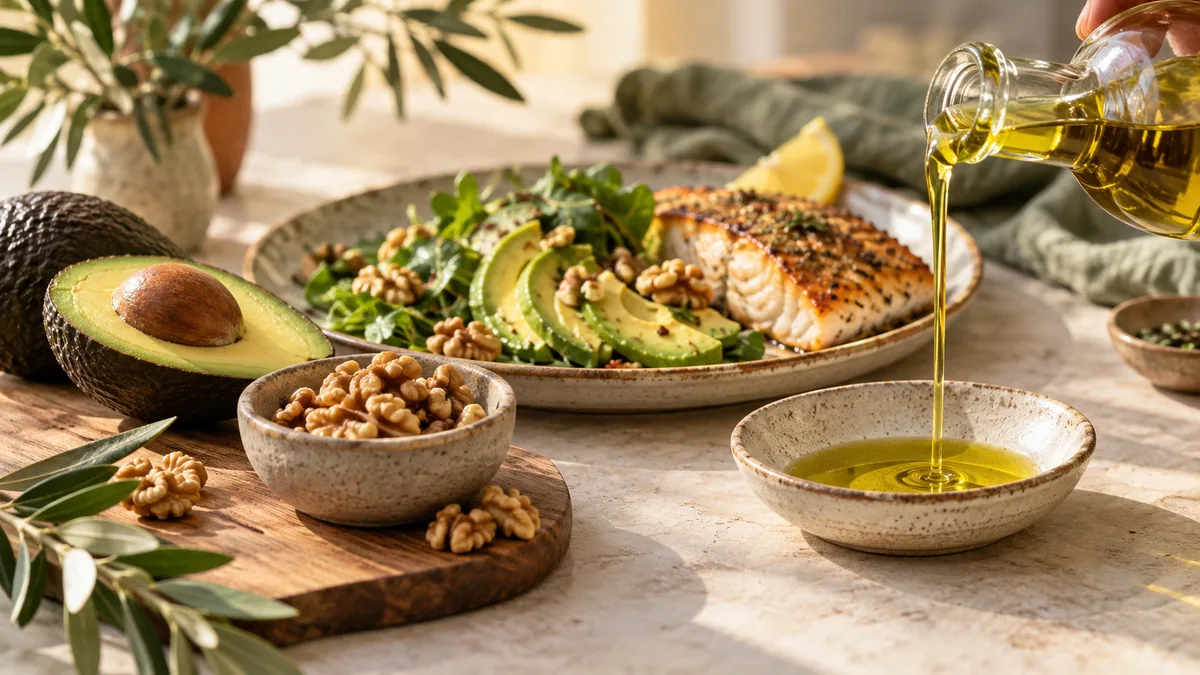
- Unsaturated fats: found in foods such as olive and canola oil, nuts, seeds and fish.
- Saturated fats: present in butter, cream, fatty meat and some plant oils, including coconut oil.
- Trans fats: industrial sources include partially hydrogenated oils; small amounts also occur naturally in some animal foods.
Most foods contain a mixture. “Plant-based” does not necessarily mean low in saturated fat.
What general guidance recommends
WHO healthy-diet guidance recommends limiting saturated fat to no more than 10% of energy and trans fat to no more than 1%, with industrial trans fats avoided. Replacing saturated fat with unsaturated fats or suitable fibre-rich foods is part of the advice.
For an illustrative 2,000 kcal intake, 10% is 200 kcal, or about 22 g of fat using 9 kcal per gram. This explains the units; it is not an individual prescription or an amount you must eat.
Oil still contributes energy
Our canola-oil reference contains 884 kcal per 100 g. Ten grams adds about 88.4 kcal. Shared evenly between four portions, that is 22.1 kcal per portion if all the oil remains in the food. Measure the amount added and acknowledge any uncertainty about oil left in the pan.
Read and compare labels
- Find whether the values are per serving or per 100 g.
- Compare total and saturated fat on the same basis.
- Read the ingredients for partially hydrogenated oil.
Update a saved recipe if you change the type or amount of fat. See the homemade recipe calculation. Protein, fibre, variety and any prescribed dietary restrictions also matter.
0Sources for this guide
- Healthy diet — WHO (2026)
- FoodData Central: data documentation — USDA (See source)